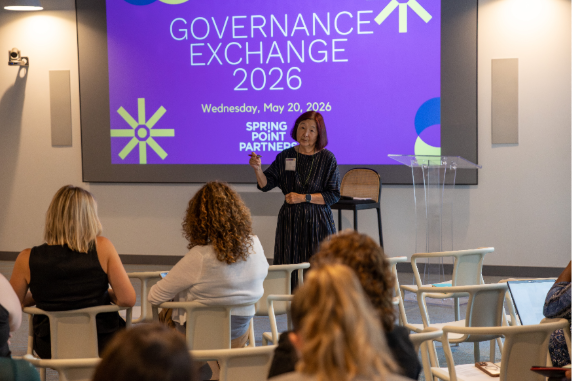



This spring, nonprofit leaders, board members, funders, and governance practitioners gathered in Philadelphia for The Governance Exchange 2026, hosted by Spring Point Partners. Centered on the theme Bridging the Gap: Governance for Resilience and Mutual Accountability, the event explored how nonprofit organizations can build resilience and strengthen governance in a rapidly changing environment.
Together, participants examined several pressing questions facing the sector:
Through a keynote from Jan Masaoka, breakout sessions led by Ameen Akbar, Dr. Alison Dougherty, Erinn Corbett-Wright and Claire Robertson-Kraft, a panel discussion featuring nonprofit executives and board leaders, and collaborative peer-learning opportunities, attendees explored practical strategies for strengthening boards, cultivating leadership partnerships, and building more resilient organizations.
The day opened with a keynote from Jan Masaoka, leader in nonprofit governance & philanthropy and a columnist at Nonprofit Quarterly, who challenged participants to rethink traditional approaches to governance and collaboration.
Rather than viewing resilience as something organizations build independently, Masaoka emphasized the importance of ecosystem collaboration and collective action. She encouraged organizations to define their core constituency and ensure governance decisions remain grounded in the needs of the communities they serve.
Her keynote also explored the distinct roles of boards and executives, emphasizing that effective governance depends on shared accountability, clear responsibilities, and a commitment to advancing organizational mission.

“Organizations must first determine who their constituency is and what the constituency needs most.”
Later in the day, Masaoka expanded on these ideas during a breakout session focused on board recruitment. Participants explored how intentional recruitment practices can strengthen governance by aligning board members with specific organizational needs and responsibilities rather than assumptions about what they may contribute.
“We cannot be afraid to ask for exactly what we want during the recruitment phase.”

Ameen Akbar, Chief Mission Officer at Philadelphia Youth Basketball, explored how organizations can create governance structures that are more inclusive, accountable, and reflective of lived experience.
Participants discussed practical strategies for ensuring community members are not simply represented, but empowered to influence decisions and shape organizational direction. The session encouraged attendees to rethink traditional board norms and consider how lived experience can strengthen governance and deepen organizational accountability.
Key takeaway: Effective governance is not just about serving communities, it is about creating pathways for communities to help shape organizational decisions.
Erinn Corbett-Wright, Principal at Ethos Advisory Services, spoke on the importance of
role clarity, onboarding, and having clearly documented procedures and policies between executives and boards.
Executive Directors and board members are going to come from differing approaches & perspectives. There must be a way to acknowledge that and establish clarity on how the roles should and should not interact with each other. The executive team and board must work together to determine the value each person can bring to the table.
Key takeaway: Strong collaboration requires both parties to respect the knowledge and expertise they bring to their respective roles.
Dr. Alison Dougherty, Equity, Compliance, Human Resource Consultant, examined succession planning as a critical governance responsibility.
Her session challenged common misconceptions surrounding succession planning and emphasized that it extends far beyond executive transitions. Participants explored continuity planning, leadership development, institutional knowledge preservation, and strategies for ensuring organizational stability during both planned and unexpected leadership changes.
Key takeaway: Succession planning is not about identifying a replacement – it is about ensuring organizational continuity and long-term resilience.

Claire Robertson-Kraft, Founder and Executive Director at ImpactED, focused on practical approaches for evaluating board performance and strengthening organizational decision-making.
Participants explored strategies for clarifying roles and responsibilities, strengthening accountability, and creating systems that support effective oversight while maintaining trust and collaboration. The session reinforced that board effectiveness is an ongoing process that requires reflection, communication, and a commitment to continuous improvement.
Key takeaway: Board effectiveness is not a destination – it is an ongoing practice of learning, assessment, and improvement.

One of the day’s most anticipated conversations was the Partnership in Practice panel, moderated by Dr. Sangeeta Tyagi, Director of the Center for Youth and Communities, Director of the Institute for Economic and Racial Equity, Senior Social Scientist, and Lecturer.
Panelists Atiyah Harmon, Founder & Executive Director of Black Girls Love Math; Danielle Scott, President & CEO of the Pincus Family Foundation; Jill Fink, Executive Director of The Merchants Fund; and Peter Gonzales, Social Entrepreneur, Lawyer & Consultant, shared candid reflections on the relationship between Executive Directors and Board Chairs.
The discussion explored how leaders build trust, maintain alignment through periods of change, and navigate difficult conversations. A recurring theme was that effective governance depends not only on structures and policies, but also on strong relationships, clear roles, and open communication. By investing in trust before challenges emerge, organizations are better positioned to navigate uncertainty and make difficult decisions together.


Artwork by Terry LaBan, Breakthrough Visuals
Throughout the convening, participants brought real governance challenges to the table, from board dynamics and fundraising expectations to leadership transitions and strategic decision-making, and worked together to identify practical solutions.
Several lessons emerged from these discussions:
Across every session, participants returned to a common idea: strong governance is built intentionally.
The Governance Exchange 2026 provided nonprofit leaders with practical tools, new perspectives, and meaningful opportunities to connect with peers navigating similar challenges. As organizations continue to adapt to an evolving landscape, the conversations shared throughout the day reinforced an important truth: resilience is not built alone, it is built together.